
Ancient Greek Military Camp Discovered in Southern Uzbekistan
An international Czech-Uzbek archaeological team led by Ladislav Stanko from Charles University in Prague has discovered Iskandar-tepa, an ancient military camp from the Hellenistic period, in southern Uzbekistan (on the border of Bactria and Sogdiana, territory that today administratively belongs to the Baysun district of Surkhandarya Region). The discovery was reported by Azattyk Asia.
According to an article published in the Journal of Archaeological Science: Reports, the team first surveyed the site in 2017 and returned in 2021 with technical equipment, including magnetometers and ground-penetrating radar, to map subsurface features.
Through magnetic surveys and ground-penetrating radar, specialists identified a defensive ditch approximately 400 metres long that surrounded an outpost covering more than 1.2 hectares. Wooden fortification traces and dozens of burial pits were also found, some dating to the 1st century BCE and later periods. Several graves substantially overlap the settlement area, suggesting the cemetery continued to be used after the camp ceased operations.
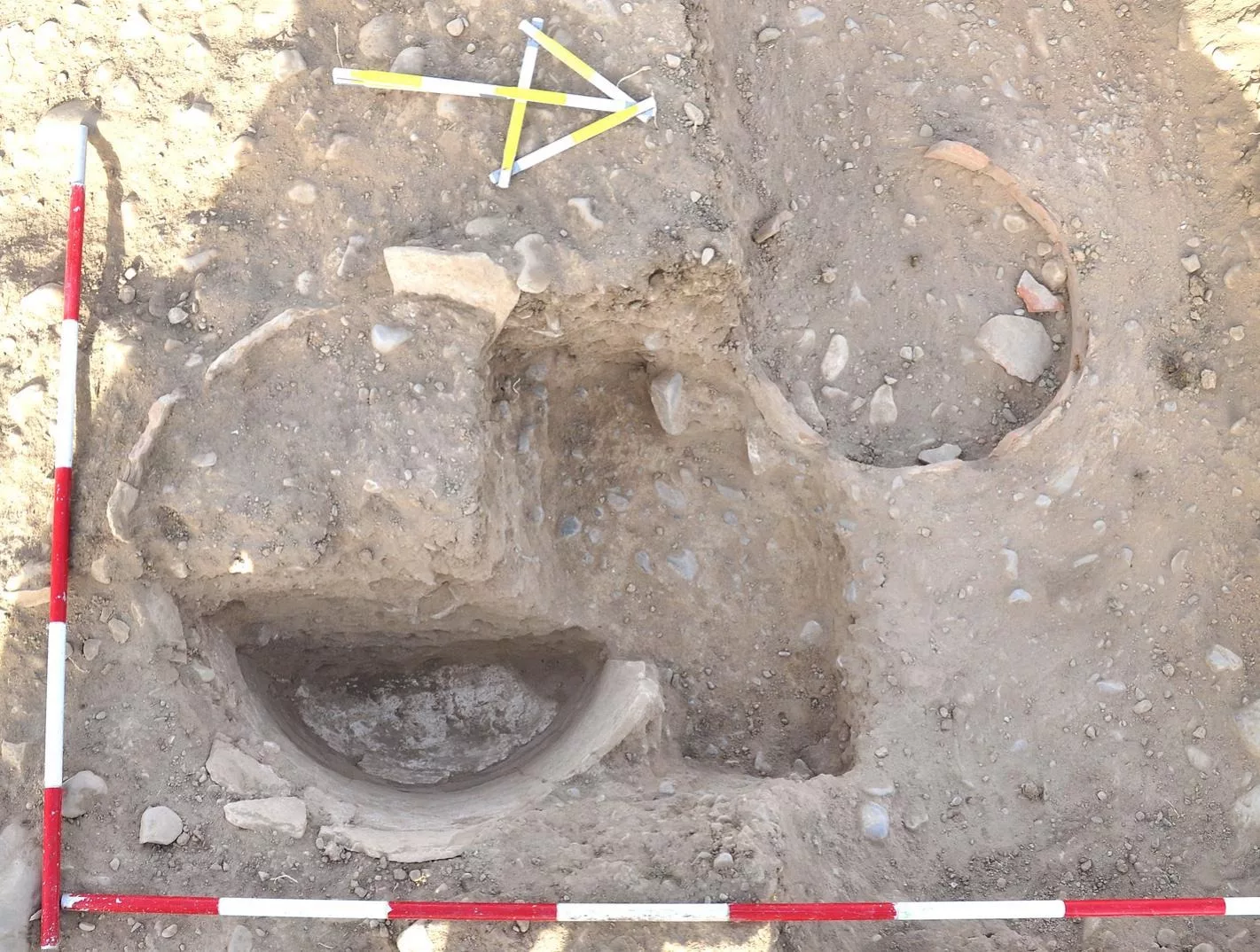
Within the enclosed territory, researchers also discovered large ceramic storage vessels, known locally as khums, buried directly in the earth. Researchers believe these vessels once held water drawn from a nearby valley or collected from a canal discovered during the survey.
According to the researchers' interpretation, this may not have been an ordinary settlement as previously assumed, but rather a temporary military camp from the Hellenistic period. This conclusion is supported by its elevated location, the defensive ditch, the absence of permanent structures, and finds of coins bearing the names of Greco-Bactrian rulers Euthydemus I and Demetrius I.
Researchers consider this discovery significant because temporary Greek military camps are rarely documented in Central Asia. In their view, such sites typically leave almost no visible traces, making geophysical methods essential for discovering what cannot be seen on the surface.
"The combination of elevated position, circular ditch, and absence of continuous structures matches historical descriptions of Greek military camps—a type of installation rarely found and documented in Central Asia," noted Professor Stanko.
According to the archaeologists, this temporary Greek garrison dates to more than 2,000 years ago.
Previously, archaeologists reported finding evidence of surgical procedures dating back 4,000 years in Uzbekistan.