
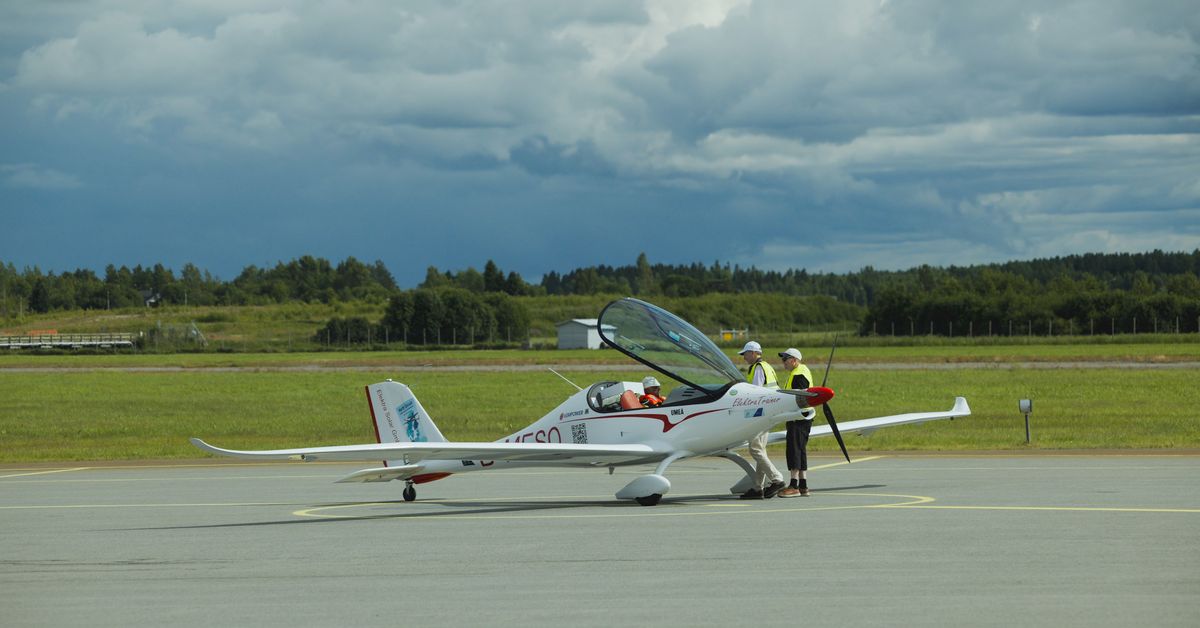
Historic electric aircraft lands at Vaasa airport
An Elektra Trainer electric aircraft made history on Tuesday when it landed at Vaasa airport, having flown from Umeå, Sweden. The aircraft is part of Oulu University of Applied Sciences' (OAMK) North Circuit flight tour, which is reportedly the first time a certified electric aircraft has crossed open sea.
The approximately 5,600-kilometre tour began last Tuesday in Bavaria, Germany, continued through Sweden to Vaasa, and will circle through the Baltic states before returning to Central Europe. In Finland, the tour culminates in Kuhmo's Fly-In event, where the public can also experience a flight in the aircraft.
The goal is to demonstrate in practice that electric flying is suitable for longer distances and varying northern conditions.
The entire tour is flown by Elektra Solar's experienced test pilot, 77-year-old Uwe Nortmann. According to Nortmann, the crossing of the Gulf of Bothnia went smoothly and faster than expected.
Test pilot Uwe Nortmann described the Gulf of Bothnia crossing after landing at Vaasa airport.
The journey through Sweden, however, was not without complications. At Storvik airfield in Sweden, thunderstorms prevented the journey from continuing last Sunday. Particularly because a lightning strike damaged the aircraft's charging system during charging.
"We called Germany, and they quickly brought a spare part," Nortmann explains.
"Since then it has been steady flying and steady charging."
The journey continued on Monday towards Umeå, and the aircraft arrived in Vaasa on Tuesday a few hours behind schedule.
Making aviation history
The flight tour includes three open-sea crossings: Germany to Sweden, Sweden to Finland, and Finland to Estonia.
According to OAMK special researcher Timo Hyvönen, the North Circuit tour is the first time a certified electric aircraft has crossed open sea. In practice, this is a commercially available electric aircraft rather than an experimental aircraft.
"This aircraft is certified in Germany; Germany and Czech certifications are recognized in Europe. You can buy this aircraft from a shop," Hyvönen summarizes.
OAMK special researcher Timo Hyvönen says the flight tour's purpose is to examine current charging facilities at airports.
Oulu University of Applied Sciences has purchased an electric aircraft for research use.
"Our aircraft arrives next spring. That's why we agreed with the manufacturer to conduct this kind of tour where we get information about how the electric motor and electric aircraft perform over long distances," Hyvönen explains.
During the tour, the current charging infrastructure for electric aircraft is also being studied.
Designed for electricity
The two-seater Elektra Trainer that crossed the Gulf of Bothnia was designed from the start as an electric aircraft, which according to Timo Hyvönen is still rare.
"Almost all other small aircraft that have been electrified are based on old combustion engines. That's why this one's shape is slightly different from traditional aircraft," he says.
Hyvönen explains that the Elektra Trainer consumes less than half the electricity during flight that would be needed to power a traditional aircraft.
"The consumption has been calculated to be very low through aerodynamics."
According to Hyvönen, the aircraft's operating time on a full battery is 2.5 hours. Charging works like an electric car with a plug from the wall and takes about three hours.
The other one of Europe's two certified electric aircraft, the Pipistrel Velis Electro, has a range of only about 50 minutes.
Challenges on the path to passenger aviation
Electric aircraft could revive smaller airports in Finland and, for example, increase domestic cross-regional traffic.
"For passenger aviation, they would certainly be excellent. Finland is that size of a country," Hyvönen muses.
According to him, this requires certification of longer-range electric aircraft and building charging infrastructure.
"That will probably take years still. It's also largely a matter for airlines: Finland has several small operators for whom 5-20 passenger flight operations would certainly be very viable," Hyvönen estimates.
According to Lasse Pohjala, project manager at Vaasa Region Development Ltd, battery technology is still a factor slowing the development of electric aircraft.
"Batteries still weigh too much, but development is surprisingly rapid. Electric aircraft are developing in the wake of the automotive industry; it's hard to imagine that any battery would be specifically developed for aviation use," Pohjala says.
Aviation's roots in Vaasa
Pohjala was organizing an electric aircraft reception ceremony at Vaasa airport. He is himself a pilot and serves as chairman of the Vaasa Flying Club.
As a pilot, he is excited about the historical nature of Nortmann's flight and its significance for the near future.
"Vaasa has great importance in aviation history, and now history is being made again," Pohjala muses.
Finland's air force history is considered to have begun when a Thulin typ D reconnaissance aircraft was flown to Vaasa from Umeå in 1918. The aircraft is regarded as the air force's first airplane, and in its memory, the Sea Eagle statue has been erected on the Vaskiluoto bridge in Vaasa.
According to Timo Hyvönen, the Gulf of Bothnia crossing by electric aircraft has been attempted since 2018—a hundred years after the first crossing of the Gulf of Bothnia.