
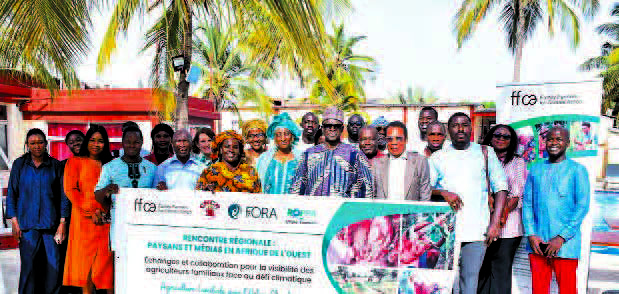
Family Farmers Network Convenes Journalists to Amplify Climate and Food Security Message
As part of the Family Farmers for Climate Action (FFCA) campaign, the Network of Peasant Organizations of West Africa (ROPPA) organized a regional dialogue workshop between farmer organizations and journalists on July 1–2, 2026, in Saly, Senegal. The goal was to find ways to better relay the challenges and opportunities tied to family farm development across West African media outlets.
Family farming occupies a central place in the socioeconomic development of West Africa. It employs more than 60% of the region's active population and produces one-third of the world's food. Yet despite being the most vulnerable to climate change, only 0.3% of international climate finance reaches family farmers. In spite of their importance, the voices of family farmers and the structural constraints they face are underrepresented or absent from media coverage.
Aware of the media's role in economic and social transformation and in shaping public policy, the Network of Peasant Organizations of West Africa (ROPPA) is determined to reverse this trend. Within the framework of the Family Farmers for Climate Action (FFCA) campaign, it organized a regional dialogue workshop between West African farmer organizations and journalists on July 1–2, 2026, in Saly, Senegal. The ambition is to find ways to ensure family farming gains visibility in the media and to foster better mutual understanding between farmer organizations and media professionals. To that end, discussions focused on "agriculture and climate," "family farming and media: current state and prospects," "understanding the media," "farmer innovation and solutions journalism," as well as critical issues such as family farm financing, climate adaptation, and seed sovereignty.
For ROPPA President Ibrahima Coulibaly, it is time to restore the image of family farming, correct the injustice it has always suffered, and give it the place it deserves. It is the sector that creates the most jobs, with four billion people worldwide earning their living from it. Unfortunately, there is no investment in family farming. As an example, only 6% of family farmers have access to agricultural credit, according to data from the African Development Bank, he lamented.
Family Agriculture in Service of Food Sovereignty
A paradigm shift is urgent, in the interests of the region. "We are not asking for charity, but for our states to create the conditions for us to develop an activity that creates sovereignty for our countries. Because a country that is dependent on food is an enslaved country. In our West African traditions, feeding one's family is a matter of dignity," Coulibaly emphasized. In his view, if the media does not understand the problems of family farming and its role in political and social stability, it will be difficult to move the needle. There are many flows of financing, but they do not reach family farms, he continued.
Family farmers need to communicate, make themselves heard, and show that they are dignified people who create wealth every day and have the capacity to ensure that Africa, for once, does not spend 100 billion dollars buying food from other countries when it is capable of producing it itself, the ROPPA president stressed.
He called on media professionals to collective awareness and co-construction toward positive transformation of family farming, with substantial financing. His call did not fall on deaf ears. While welcoming the initiative, information professionals committed to covering the challenges of family farming in their columns and on their platforms.
"Family farms play a crucial role in the growth of our countries' economies, and we truly must do our part for the development of this important sector," said Gilles Essonana Podjoley, president of the network of journalists promoting agro-sylvo-pastoral and fisheries systems in West Africa and the Sahel (ReJPAH-AOS) and publisher of Togo's Agricultural Journal.
Mahamadi SEBOGO
Windmad76@gmail.com (Returning from Saly, Dakar)