
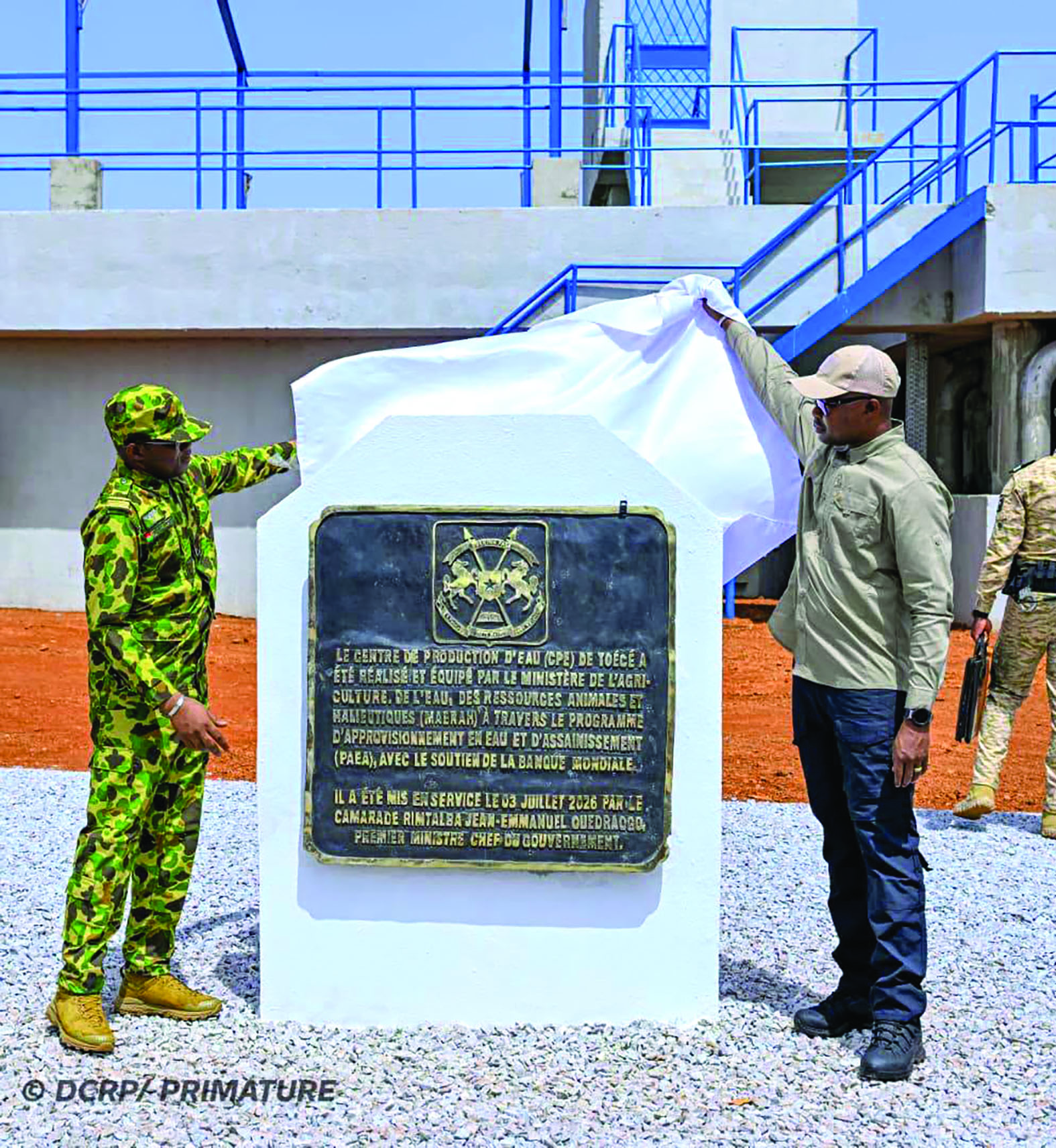
Prime Minister Commissions Water Infrastructure in Yaadga Region
On Friday, July 3, 2026, Prime Minister Rimtalba Jean Emmanuel Ouédraogo, accompanied by State Minister Ismaël Sombié (Minister of Agriculture, Water, Animal and Fisheries Resources), commissioned water production facilities and pumping stations in the Passoré province of Yaadga region. The Prime Minister also launched construction work to strengthen the drinking water supply network for the city of Ouahigouya, connecting from Gourcy. In Arbolé, he commended local communities, particularly women, for developing a 33-hectare rice paddy.
Long-standing water shortages in the region are now being addressed through major infrastructure investment. Communities in Dourou village (Kirsi municipality), and the towns of Yako and Gourcy witnessed the commissioning of multiple hydraulic facilities. Ouahigouya residents will soon celebrate the completion of water network connections originating from Gourcy, officially launched by the Prime Minister. The city of Boussé in Oubri region will also benefit from these water investments.
Traditional leaders, administrative authorities, and residents attended the commissioning of the Dourou Water Production Centre (CPE). With a daily production capacity of 10,000 cubic metres of drinking water, the facility was built and equipped by the Ministry of Agriculture through the Water Supply and Sanitation Programme (PAEA), with financial support from the World Bank and other investments totalling 17.9 billion CFA francs.
Supplying Three Cities
PAEA coordinator Ibrahim Belem explained that the CPE, valued at over 15 billion CFA francs, will simultaneously supply Yako, Gourcy, and Boussé. "To serve these three cities, the CPE is connected to four reinforced concrete water tanks of 300 cubic metres each. The first is located in Dourou, while the other three are in Yako, Gourcy, and Boussé. Each tank has a pumping station and treatment facility. They are connected to the CPE through an integrated drinking water supply system serving all three towns simultaneously," he said.
The integrated system crosses eight villages—Dourou, Pougyango, Niessèga, Petit-Samba, Niou, Arbolé, Zongbèga, and Pélegtanga. Each will have a 50-cubic-metre metal reservoir, with reinforced concrete structures allowing installation of water points and private connections. "In total, more than 138,000 people will gain access to drinking water through 112 water points, 2,200 household connections, and 149 kilometres of distribution network. By 2030, nearly 250,000 people will benefit from the CPE's services."
The Prime Minister said the water facilities address a fundamental issue—that after more than 60 years of independence, Burkina Faso still has populations without access to clean water. "Water is not a privilege but a right. We cannot claim to support the development of our populations if we do not solve these elementary problems," Ouédraogo said.
After Dourou, the delegation moved to Yako to commission the city's water treatment station, then inspected Gourcy's drinking water system. Ouédraogo formally launched work to strengthen Ouahigouya's water supply from Gourcy at a cost exceeding 7.3 billion CFA francs.
The PAEA will install a supply system from Gourcy's pumping station to Ouahigouya's existing water tank. A main pipeline will run along National Route 2 from the Dourou CPE via Gourcy to Ouahigouya. "This investment will eliminate Ouahigouya's water deficit and also benefit seven other rural communities along Route 2: Bougounam, Zindiguessé, Rombagare, Koudombo, Bilinga, Bourbo, and Somiaga," the PAEA coordinator said.
The Prime Minister assured that the government will not leave any Burkinabé city without water solutions, despite the scale of the challenge.
World Bank Support Continues
The World Bank's resident representative in Burkina Faso, Hamoud Abdel Wedoud Kamil, reaffirmed the institution's commitment to supporting the government's major development investments. The Prime Minister appreciated the Bank's alignment with national priorities and the progressive populist revolution's demand for speed. The National Water and Sanitation Office (ONEA) and beneficiary communities are urged to work together to protect infrastructure and maintain service continuity.
Yaadga region's governor, Thomas Yampa, expressed gratitude on behalf of residents for the Dourou CPE, describing it as a strategic tool for reducing social inequality.
After visiting Yako and Gourcy to inspect related facilities built under PAEA, the Prime Minister formally launched the Ouahigouya water network strengthening project. He told assembled residents that President Ibrahim Traoré had given firm instructions to implement rapid solutions to water access difficulties.
"Solutions to our problems lie in our own hands. We must reject complacency and servitude and believe in ourselves. We are prepared to make the sacrifices necessary to guarantee better futures for coming generations," he declared.
Stopping in Yibi village near Arbolé, the Prime Minister commended women for developing a 33-hectare rice paddy through the "Tin Taan Soani" ("Let Us Build Together") initiative, emphasising mutual aid, local participation, and civic action. The site offers 450 individual plots of 625 square metres each with water management systems to improve rainy-season rice yields. A total of 251 farmers from Niou, Poura, Saaba, and Arbolé are involved, 90 percent of them women, with expected rice production of 132 tonnes. The Prime Minister said he would address concerns raised during his visit.