
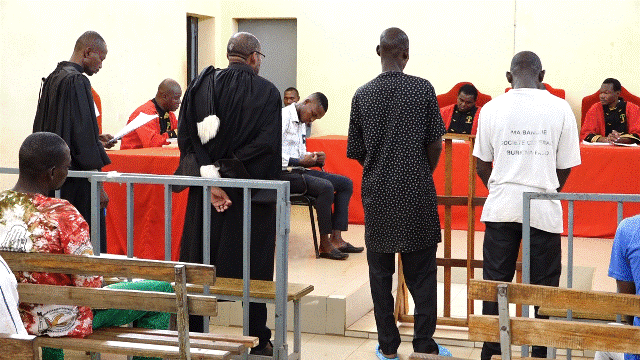
The Criminal Chamber of the Court of Appeal of Bobo-Dioulasso, sitting exceptionally in Gaoua, re-examined on Thursday, July 2, 2026, the case of the murder of three agents of the Center for Control of Motor Vehicles (CCVA), lynched in Banlo in August 2021. Before the tribunal, two appellants expressed their regrets and sought clemency from the court, while the public prosecutor and the civil party defended the maintenance of the convictions handed down at first instance.
Gaoua, Thursday, July 2, 2026. It is just before 8 a.m. Unlike the first trial, which had attracted large crowds from the earliest hours, the courtroom of the High Court of Gaoua is still quiet. Only a few people cross the threshold of the Palace of Justice. In the nearly empty courtroom, the lawyers for the defence and the civil party are seated in the front row.
Yet everyone knows that the proceedings about to open concern a case that has deeply marked the Djôrô region: the murder of three CCVA agents, lynched in Banlo, in the commune of Bouroum-Bouroum, on August 27, 2021. The case remains etched in memory. That day, a traffic accident had cost the life of a 10-year-old child in the village of Banlo. Within minutes, anger had seized part of the population. The three CCVA agents, who were trying to escape the crowd, had been chased into a cornfield, where they were killed with extreme violence. Their bodies were then hidden. At first instance, five defendants had been sentenced to life imprisonment, three of them in absentia. Others had received prison sentences, while some had been acquitted. The families of the victims had also obtained damages. But on Thursday, July 2, 2026, a new examination of the case opens before the criminal chamber of the Court of Appeal of Bobo-Dioulasso, sitting exceptionally in Gaoua.
Shortly after 8 a.m., the judges of the Court enter the room, followed by the public prosecutor. Silence descends immediately. The few conversations stop. Everyone takes their seat, aware of the importance of the hearing opening.
Before addressing the substance of the case, the president carries out the usual formalities. The two defendants who have appealed are invited, one after the other, to state their identity. The first to come forward is Djogarè Kambou, a 52-year-old farmer. Next comes Sonkoté Kambou, also a farmer, aged 55.
The chief judge then opens the proceedings by recalling the facts and the charges against the two appellants. Djogarè Kambou and Sonkoté Kambou are being prosecuted for murder, acts of vandalism, illegal possession of a firearm and ammunition. To these charges is added, for Djogarè Kambou, an additional accusation: incitement to commit a crime.
Pleas for clemency amid contradictions
The president first addresses Djogarè Kambou. "Why have you appealed?" he asks him. The defendant does not contest the facts. In a calm voice, he explains that his approach aims solely to obtain clemency from the court. "We ask for forgiveness. If you can help us," he declares.
The president immediately corrects him. "What do you mean by 'help us'?" Djogarè Kambou responds that he is the father of a large family. "I have three wives and nine children. Right now, it is difficult for them," he explains. The president continues: "Then why are you requesting a reduction of sentence?"
The defendant claims that if he ever regains his freedom, he will put his experience at the service of his community. "If I manage to get out, I will go and raise awareness among the brothers of the village."
The magistrate returns to the facts. "Were you present at the scene? How many people were killed?" "Yes… Three people," the defendant replies. The judge notes that, according to the investigation evidence, the young boy who died in the accident was crossing the road from the wrong side, then continues: "When you caught up with the victims, what happened?" Djogarè Kambou claims he did nothing. This answer does not convince the Court. "You are changing your story to save yourself. Yet when one asks for forgiveness, the minimum is to have the courage to explain what really happened," the magistrate observes.
The judges note that the victims had begged their attackers before being killed. Faced with these remarks, the defendant renews his regrets. "We really messed up. I don't really know what was going through our heads," he admits. But the Court insists. "For the court to appreciate your plea for forgiveness, you must still explain what happened. You stopped them. Why did you neither take them to the police nor the gendarmerie? Why did you kill them when they were involved in a traffic accident?"
The judge continues, in a firm tone: "You killed them, and today you believe you should go home and resume the course of your life, is that right?" The courtroom remains silent. Everyone follows this exchange between the Court and the first appellant with attention.
The public prosecutor speaks and responds directly to the arguments advanced by Djogarè Kambou. "You say you have three wives and nine children. But do not forget that you have made three widows and many orphans," he tells him.
For the representative of the public prosecutor's office, the defendant is perfectly entitled to appeal. However, this step must be accompanied, in his view, by a full acknowledgment of his actions.
"You had all the time to explain yourself before the investigating judge. Why try to deny today the facts with which you are charged? You must take responsibility," he insists.
The lawyer for the civil party intervenes in turn and recalls that after the lynching of the three CCVA agents, their bodies had been hidden in a cornfield while security forces were actively searching for them. For him, the elements of the case are unambiguous. "They were indeed on the scene. The facts are established," he argues. The defence lawyer then speaks and addresses his client directly. "What do you think today about what happened?" he asks him. Djogarè Kambou replies that what happened is regrettable. "I have children and I do not wish that a single one of them ever finds himself in such a situation," he pleads.
The Court then hears the co-defendant, Sonkoté Kambou, who also indicates that he has appealed in the sole hope of obtaining clemency.
He first denies any direct involvement in the murders. "When I arrived at the scene, they had already been murdered. I don't know how they were killed, whether it was with pieces of wood or firearms," he declares. But faced with repeated questions from the chief judge and contradictions noted in the case file, his account evolves. After several confrontations, he eventually admits to using his weapon, while claiming he only fired into the air. "When I fired, I stopped trying to understand," he explains.
This version hardly convinces the chief judge. "You can continue to lie, the audience will listen to you. But the clemency you are requesting will also depend on your ability to tell the truth. If we are asking you questions, it is both for and against you," the magistrate reminds him.
The defendant limits himself to renewing his plea for forgiveness. "I ask your forgiveness. Even after my death, no"