

Literature by Black Authors Explains Brazil's Historical Racism and Contests National Narrative, Says Writer Ana Maria Gonçalves
Literature produced by Black authors helps explain the historical persistence of racism in Brazil and contests the very meaning of national narrative, according to writer Ana Maria Gonçalves. The author of the acclaimed novel A Defect of Colour spoke with Agência Brasil during a visit to Brasília on Saturday afternoon (4 July).
The first Black woman to become immortal at the Brazilian Academy of Letters (ABL), the writer was the special guest of the 6th edition of the gathering July of Black Women Who Write in the Federal District, as part of the programming of Festival Latinidades.
Ana Maria says that A Defect of Colour and other works have contributed to broadening society's understanding of racism and strengthening debates such as that of racial quota policies, whose first experiments coincide with the year the book was published, in 2006.
"Books like mine, like those of several other Black writers and female writers who have been producing in contemporary times, help tell a story so that the Brazilian people understand the reason for the need for quotas. We have always known why we needed them, but for so long it was hidden and racism was a taboo subject within Brazilian society," the writer points out.
Her most impactful novel is a monumental 952-page narrative that tells the life saga of Kehinde, a Black woman who, at eight years old, is kidnapped in the Kingdom of Dahomey, present-day Benin, and brought to be enslaved on the Island of Itaparica, in Bahia.
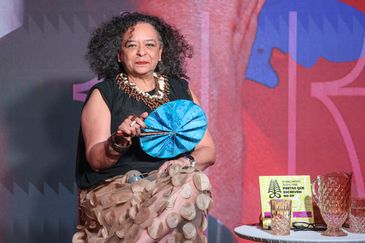
Ana Maria Gonçalves during interview for Agência Brasil at the VI gathering July of Black Women Who Write - Valter Campanato/Agência Brasil
The book is considered by critics one of the most important novels of contemporary Brazilian literature and inspired the acclaimed samba-enredo by the samba school Portela at Rio's 2024 carnival. According to Ana Maria Gonçalves, narratives like these help understand the country's history from perspectives historically marginalized in Brazilian literature.
The author understands that the novel is a history that has not yet ended, a history that began in 1530, with the arrival of the first Africans in Brazil, and that continues to this day.
"I very much like to cite that song by Rapa: 'Every police van carries a bit of a slave ship.' We continue to be the bodies that are being persecuted, that are being arrested, that are being killed, that are counted as numbers and not as stories".
Ana Maria Gonçalves also rejects the label of counter-history to characterize the representativeness of works like hers in the dispute for a historical sense of country.
"A Defect of Colour is the history of Brazil told through the eyes and lived experience of a Black woman. It is not another version, it is not another strand, it is not opposing a place. It wants to occupy that same place that the official history of Brazil has always occupied, told mainly through the gaze of white men," she emphasizes.
"I want to dispute that place, I am not interested in the margin, I am not interested in the counter, the counter-proposal, the counter-history. The book is history".
Ancestry at the ABL
Since taking chair 33 at the ABL, as only the 13th woman and the first Black woman to be elected to the academy, Ana Maria Gonçalves has made a point of repeating that she did not arrive at this place alone.
"The first woman elected, Raquel de Queirós, was only elected after a campaign by Diná Silveira de Queirós. And my election has a lot to do with Conceição Evaristo's candidacy. It was at that moment that Brazilian society looked at the academy and said: 'Wait, isn't it the Brazilian Academy of Letters? There's someone missing here who represents the largest ethnic segment of Brazilian society, which is the Black woman. We are 27% of the population," she reflects.
Literary Market
At Festival Latinidades, Ana Maria met in a space of exchange with Black women—authors and readers—to think together about the current impact of this network on the country's own literary market.
"Nothing more can be done without us," she emphasizes.
The writer cites Maria Firmina dos Reis, considered the first Black female novelist in Brazil, author of Úrsula, a work from 1859. "From then until 2006, I was the eighth Black woman to publish a novel in Brazil. It is still a very large gap. Society owes us this place to publish and write," she adds.
The greater visibility achieved by Black writers over the past two decades has increased interest in works by Black authors and driven changes in the publishing market, observes Ana Maria Gonçalves.
"What we produce is no longer read as it was for a long time, as pamphlet literature, as inferior quality. We no longer need to discuss that. We have Jefferson Tenório, Conceição Evaristo, Eliana Alves Cruz, Cidinha da Silva and many others. And a very interesting generation of Black women writing on the outskirts of São Paulo today is coming. And already rebelling in other places that are no longer these centers, like São Paulo and Rio de Janeiro," she contextualizes.
"We are changing the publishing market in the sense of showing that diversity is also welcome for those who are just looking for profit".
Black Female Authors
Organizer of the collective that promotes Black female writers in the DF, journalist Waleska Barbosa mediated the conversation with Ana Maria Gonçalves at Festival Latinidades. She recognizes an important advance in the publishing market but points out limits and contradictions that still impact the literary production by Black authors.
"Publishing a book is expensive. And publishing is not just one thing. There is circulation, distribution, criticism, awards. When we scrutinize the numbers, the statistical advance is never that much." Another challenge is the permanence of Black writers and authors in these spaces, still marked by episodes of racism.
The example of Black writer Lilia Guerra is still quite glaring in this scenario, Waleska points out. Invited to the International Literary Festival of Paraty (Flip) last year, Guerra was unjustly accused of theft at the hotel where she was staying in the Rio de Janeiro city.
"I say that we are victims, a Buarquiana Geni in that sense. At one moment she was a writer, invited to Flip, a while later she is accused of theft, being that same person, that same writer. Conceição Evaristo, honored in a major exhibition in São Paulo, has also already said that as she walks down Avenida Paulista, she continues to be subject to everyday racism," she laments.