
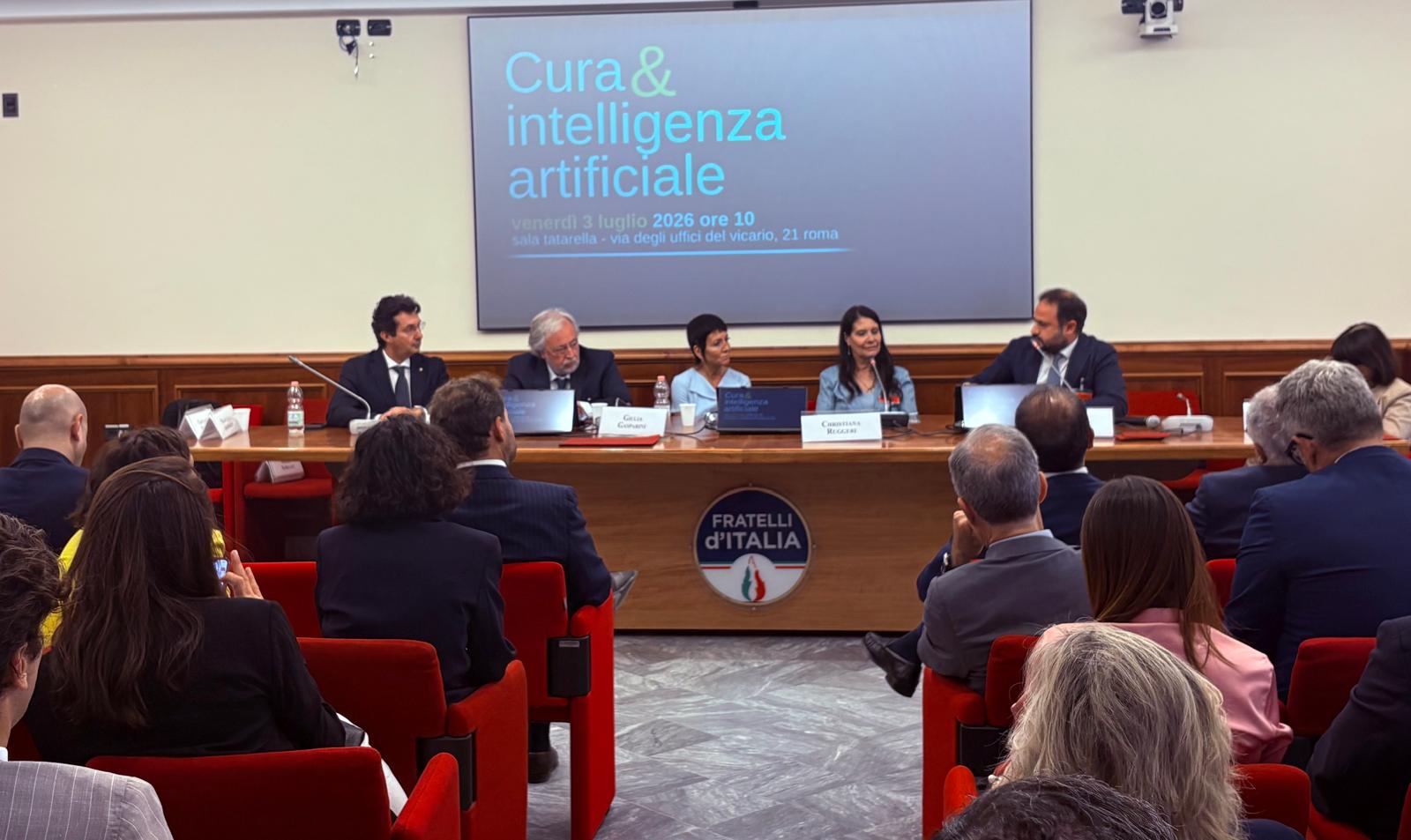
From oncological diagnosis to neurotechnologies, passing through prevention, cloud computing and data governance: at Parliament, the debate on how Artificial Intelligence is transforming the relationship between medicine, patients and the National Health Service
04/07/2026
"When an oncology patient receives a diagnosis, they experience a real existential earthquake." It is from this image, evoked by Professor Luca Tagliaferri during the conference "Care & Artificial Intelligence", held yesterday at the Chamber of Deputies by Andrea Mascaretti and organized by the Brothers of Italy group, that the connecting thread of the entire day emerges: Artificial Intelligence is not only changing the way diseases are treated, but the very meaning of care itself.
Opening the proceedings, Mascaretti, national head of the AI and Strategic Technologies Department of Brothers of Italy, indicated the direction of the initiative: "The real challenge is not understanding whether artificial intelligence will change healthcare: it is already doing so. The challenge is to make Italy the European reference point for this new frontier, placing the person, research, security and every patient's right to access the best available technologies at the center".
Care beyond illness
Not a metaphor, that of the "existential earthquake", but a measurable biological phenomenon. The stress caused by diagnosis increases cortisol levels and cortisol, in turn, produces immunosuppression. Curing fear, in short, also means curing the body.
From this insight Art4ART is born, the project of the Agostino Gemelli University Hospital Foundation Irccs presented by Tagliaferri, head of the Gemelli ART Interventional Radiotherapy Unit. The idea is that patient resilience and their spiritual dimension do not represent a simple corollary of the therapeutic pathway, but an element capable of directly impacting care. Through artificial intelligence systems applied to patient profiling, the Gemelli team has developed immersive environments in which each patient can choose the visual and sound scenario in which to face, for example, a chemotherapy session. In the video projected during the conference, some small oncology patients tell with surprising naturalness about their own experience: "There is nothing to cry about, I feel no pain".
Alongside the Gemelli experience, the clinical picture was completed by interventions from Professor Stefano Mannino, neurosurgeon at the Neurosurgery Unit of the Cardarelli in Naples, and Professor Bruno Beomonte Zobel, director of the Diagnostic Imaging Unit, coordinator of the Imaging Center and director of the School of Specialization in Radiodiagnostics at the Campus Bio-Medico University Hospital, who highlighted the perspectives opened by artificial intelligence respectively in neurosurgery and diagnostic imaging.
The Gemelli experience shows how artificial intelligence can impact the most human dimension of medicine. But for this change to become a heritage of the National Health Service, infrastructure, investment and a system strategy are needed.
Undersecretary of Health Marcello Gemmato defined Artificial Intelligence as "an extraordinary driver of sustainability" for the National Health Service. Predicting the onset of a disease, he explained, means intervening before the disease fully manifests, initiating faster diagnostic and therapeutic pathways and thus contributing to reducing the economic burden of diseases on the healthcare system.
The technologies that make new medicine possible
For this transformation to become widespread clinical practice, algorithms alone are not enough. Digital infrastructure, computing power, research and investment are needed. It was on this ground that the debate shifted, bringing together two complementary perspectives: that of cloud computing applied to healthcare and that of next-generation neurotechnologies.
Giulia Gasparini, Country Manager of Amazon Web Services Italy, recalled that 72% of European citizens indicate healthcare as the top priority for public investment, seeing artificial intelligence as a tool to improve efficiency, accessibility and diagnostic speed. AWS proposes itself as the cloud infrastructure on which AI applications can move from the experimental dimension and become concrete tools of healthcare practice: from the 80% reduction in admission times achieved in Germany by CareMates to the halving of drug development times for rare diseases achieved by Iktos in France, to the Acciaio project of Azienda Zero Veneto, which reduced documentary evaluation times for accreditation of healthcare facilities by 30-50%.
On the Italian front, Gasparini recalled the experience of Di Venere Hospital in Carbonara di Bari, where the eVai platform, developed by enGenome, a spin-off of the University of Pavia built on AWS infrastructure, reduced the average time needed to reach a diagnosis of a rare genetic disease from seven-eight years to approximately one month. A result that changes life before technology even does: "It is not a game changer, it is a life changer".
On an even more advanced frontier was the intervention of Giuseppe Santella, CEO of Corticale, a Genoese startup founded in 2021 as a spin-off of the Italian Institute of Technology. The company develops SiNAPS, an implantable brain-computer interface capable of communicating with thousands of neurons distributed across different cortical and subcortical areas. The stated objective is exclusively clinical, a choice incorporated in the company's statute, with possible applications in multiple sclerosis, ALS, Parkinson's disease, epilepsy, neuropathic pain and sequelae of stroke, spinal cord injuries, traumatic brain injuries and tumors. An area that, according to estimates presented during the conference, affects one person in three worldwide, for an overall market estimated at 164 billion dollars and approximately 2.8 billion patients.
Governing innovation
To bring these different levels together, from personal care to digital infrastructure, to the most experimental technologies, within a system framework was Health Minister Orazio Schillaci, who indicated three "essential" principles. The first concerns the ownership of health data: it belongs to citizens, not to platforms or structures that collect it. "The Electronic Health Record is not a bureaucratic obligation, but the precondition for artificial intelligence to work in the interest of those who are then treated". The second concerns the role of doctors: AI "must be a new ally, not a substitute", because responsibility for diagnosis always remains with a professional who knows the patient and their context. The third is that of equity: innovation cannot stop at large facilities, because "an Italy with two speeds of technology does not mean progress, but yet another inequality disguised as modernity".
The minister recalled that the Recovery and Resilience Plan allocated more than 15 billion euros to the Health Mission, with the delivery of over 3,000 large diagnostic equipment to Italian hospitals and an Electronic Health Record now active for over 57 million citizens, of whom more than 25 million have already expressed consent to consultation of their data.
"Artificial intelligence alone does not cure anyone", Schillaci concluded. "It needs reliable data, modern infrastructure, skills and clear rules and, above all, a National Health Service capable of integrating it into clinical practice in the service of citizens".