
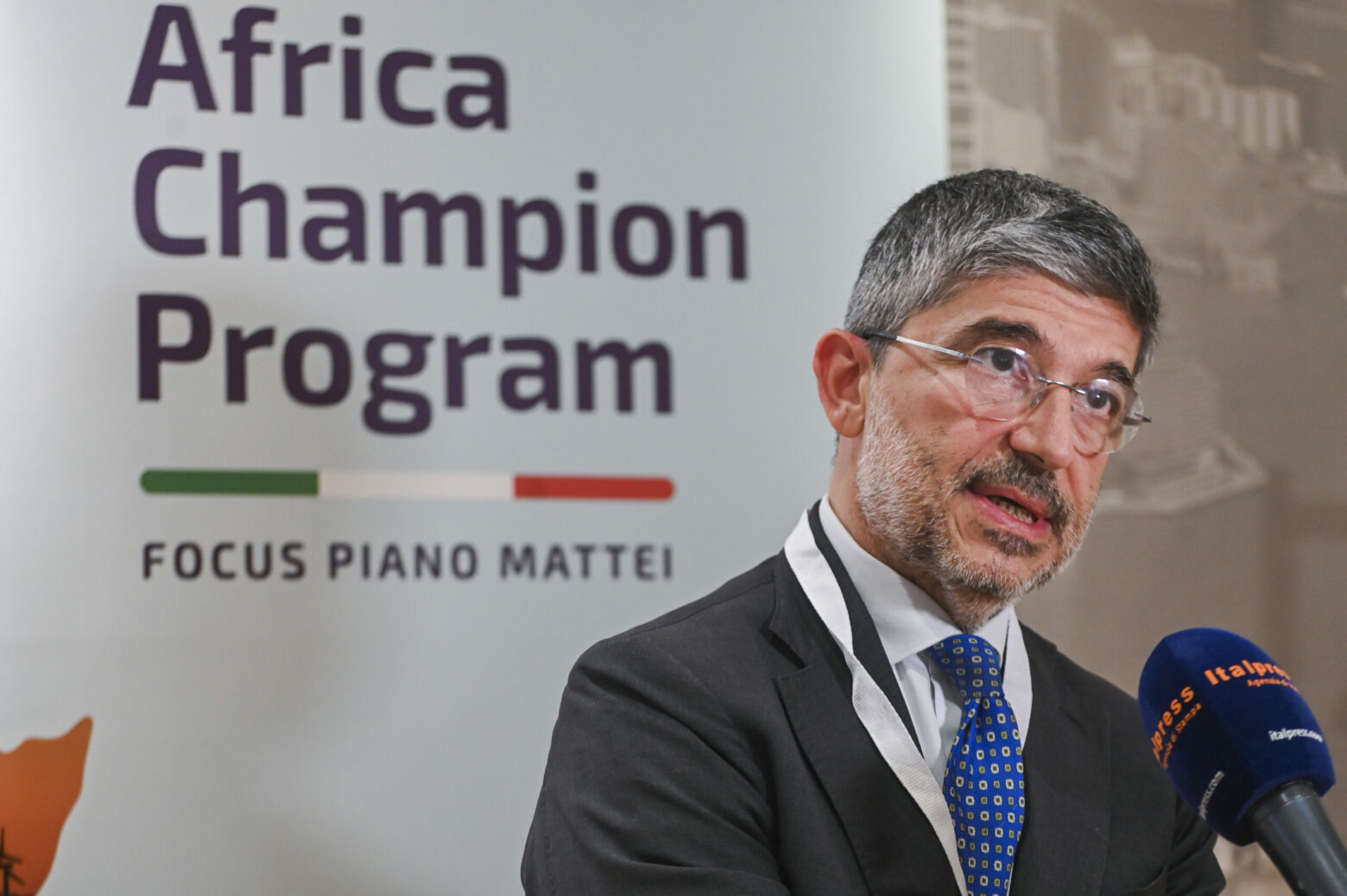
At the 2026 Africa CEO Forum in Kigali, held under the theme "Scale or Fail", Italy presented itself as an integrated national system within the framework of the Mattei Plan, focusing on long-term partnerships between energy, infrastructure, production, finance and innovation. In this interview, Fabrizio Lobasso — former Italian ambassador to Sudan and head of the Italian delegation in Kigali — explains why Africa should be seen not simply as a market, but as a strategic partner for shared growth trajectories.
31/05/2026
In Kigali, for two days, the most repeated word was not only "growth". It was "scale". The Africa CEO Forum 2026, held on May 14 and 15 in the Rwandan capital, chose a clear, almost ultimative title: "Scale or Fail". Grow at scale or remain trapped in fragmentation. Build continental champions or continue to depend on isolated projects. Attract patient capital or suffer the volatility of an increasingly selective global finance.
Within this narrative, the climate issue in its aspects linked to the internationalisation of Italian companies entered as a constraint, as an opportunity and as a selection criterion for investments. Because today, in Africa, talking about growth also means talking about accessible energy, resilient networks, agriculture capable of adapting, infrastructure that withstands climate shocks, digital and artificial intelligence applied to productivity, water management, and risk forecasting. All elements crucial for companies in our country to enable long-term partnerships on the continent.
Italian participation
Italian participation followed the path of the Mattei Plan, with the objective of strengthening an even more structured economic presence in sectors where the relationship between business, development and climate resilience is most evident: energy, infrastructure, agribusiness, manufacturing, digital technologies and advanced services.
Ahead of the Forum, the Ministry of Foreign Affairs, with the support of the Italian Trade Agency, planned activities dedicated to highlighting the Italia System, with particular attention to the supply chains of industrial machinery, infrastructure and construction. But Kigali also posed a deeper political question. Who decides the trajectory of African growth?
Rwandan President Paul Kagame called for Africa to better defend its strategic interests, and at the same time the organisers insisted on the culture of shared ownership, that is the sharing of capital, risk, part of governance and values of encounter between African and international actors.
To understand what really emerged in the panels and corridors of the Forum, we interviewed Fabrizio Lobasso, former Italian Ambassador in Khartoum in Sudan and head of the Italian delegation in Kigali. With him we tried to read, from the perspective of those representing the Italia System, what opportunities and risks are opening today in the relationship between Africa, innovation and investment.
Ambassador, the Kigali Africa CEO Forum had a very clear title, "Scale or Fail". But I would like to shift the point of view to Italy. What did it concretely mean to be present in Kigali as a Nation System and not as individual institutional or industrial actors?
Kigali confirmed with great clarity that Africa is not looking for episodic interlocutors, but partners capable of accompanying processes of structural growth. For this reason, Italian participation could not be limited to institutional representation or a commercial showcase. We had to present ourselves as a System, bringing together institutions, associations, companies, development finance, guarantee instruments, technology and industrial capacity. The point is precisely this. If Africa is to grow at scale, Italy must also move at scale. Success of a single company, however excellent, is no longer enough. We need to propose ourselves with a recognisable supply chain, capable of creating solutions, training, structuring, credit, local partnerships and continuity. In Kigali we sought to convey a clear message: Italy can be a reliable partner not because it imposes a model, but because it knows how to build industrial relations, adapt its own competences to local contexts and work with African actors in a logic of intercultural co-design.
The Mattei Plan is often read primarily as a political framework. After Kigali, can we say it is also becoming an operational tool for internationalisation for Italian companies? And what concrete returns can we expect from a mission like the one in Rwanda?
The Mattei Plan should be highlighted among many things for its ability to transform itself into projects, industrial relations and measurable opportunities. The political dimension is fundamental, because it creates trust and opens institutional channels. It is a lever that allows us to obtain results by generating partnerships, financial agreements, industrial presence, shared supply chains. And the Ministry of Foreign Affairs is carrying out work of refinement and unconditional support in this regard.
Returns should not be read only in immediate terms. A mission like the one in Kigali produces contacts, reputation, market knowledge, relations with local institutions, dialogue with development funds and banks, opportunities for industrial associations and companies. It is the patient work of growth diplomacy. It does not always produce results in the coming weeks, but it creates the conditions for Italian companies to be present when projects mature and when our African interlocutors, recognising our excellence, seek us out again.
Ucima was also present in Kigali, with a focus on instrumental mechanics and packaging machines. Why bring this sector to the Africa CEO Forum? What does it tell us about possible Italian presence in Africa?
The presence of Ucima was very significant, because it tells an essential part of Italian strength. When we talk about African industrial development, we are not only talking about large infrastructure or large energy investments. We are also talking about the ability to build production supply chains, to transform raw materials and strengthen agro-industry; to improve packaging, to guarantee product traceability and their suitability for export. Italian instrumental mechanics is particularly suited to this transition. It offers not only machines. It offers expertise, the ability to adapt products to local requests, technical assistance and training. It offers the ability to work on different productions and on evolving industrial contexts.
In many African countries the issue is not simply the import of technology, but building sustainable local productive capacity. In this sense, the industrial machine becomes an instrument of development, not just an exported good. The seminar with Ucima showed precisely this value. It put before African (and other) interlocutors a tangible, operational piece of industrial Made in Italy, not rhetorical, not decorative, but directly linked to the growth of supply chains. If Africa wants to industrialise more and retain more value on its territory, Italian mechanics can be a natural path.
In Kigali, Cassa Depositi e Prestiti played an important role also through the agreement linked to the Italian Fund for Climate and the Banque Rwandaise de Développement. How much does it matter, for the credibility of the Italian presence, to be able to accompany economic diplomacy with concrete financial instruments?
It matters enormously, it is a crucial element. Companies alone cannot succeed if not backed by public and private financial capacity. The Mattei Plan is political, diplomatic, industrial and financial all together. Financial instruments are not decorative; they are operational. They allow us to structure longer-term partnerships, to share risk, to support African partners in making transformative investments. When we arrive with diplomacy, competence and concrete financial capacity, the conversation changes. We are not just offering products or services. We are offering a partnership model. Cassa Depositi e Prestiti's presence in Kigali — with its capacity to mobilise capital, to structure green finance, to work with development banks — sends a signal that the Italian system is serious, that it is present with all its tools. It is the difference between being a guest and being a partner.