
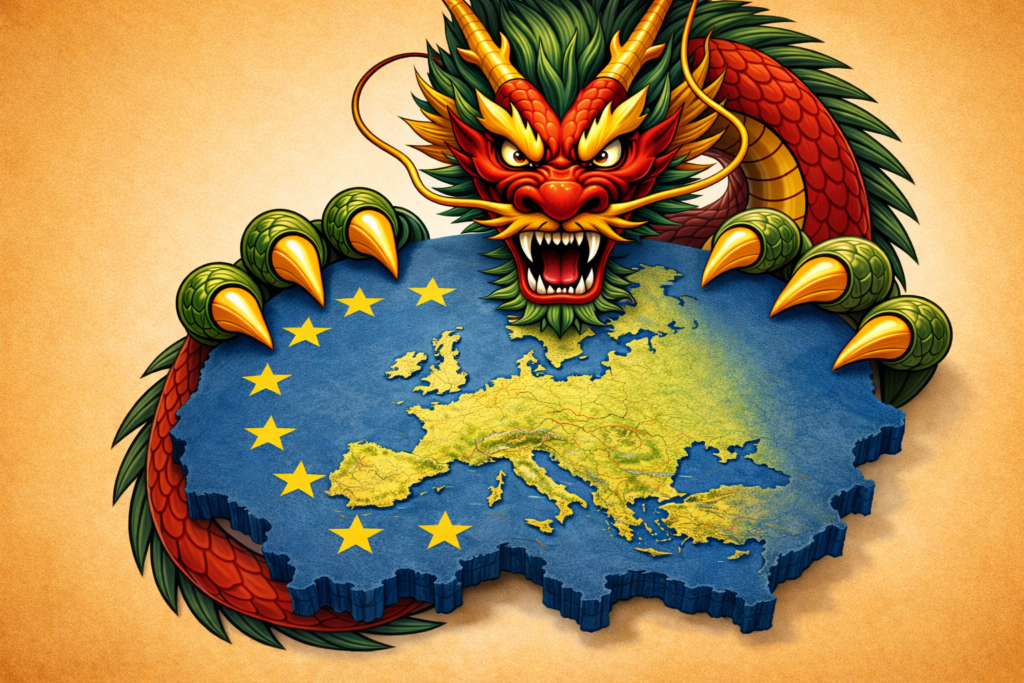
China senses trouble
The EU may be able to react against the Dragon and its distorted, unhealthy market system. But Beijing can always pressure European companies that source Chinese products to try to circumvent Brussels' rules. Here's how and why.
China smells trouble. So much so that it is intensifying threats of economic coercion against Europe. Angry, quite simply, at having had its eyes opened and its head raised—at rebelling against a distorted, aggressive, and unfair market system. In April alone, China's State Council issued Provisions on Industrial Security and Supply Chain Security (which require its companies not to comply with EU investigations or sanctions), cut dual-use supplies to seven European defence contractors because of support for Taiwan, and launched explicit threats regarding EU proposals on the Industrial Accelerator Act and the Cybersecurity Act.
Trade data, however, as a European Council for Foreign Relations report clarifies, do not capture the political mechanism at play. "Even if China never actively used these coercive laws, they contribute to self-sanctioning by Europe. If European policymakers were to abandon them preemptively out of fear of retaliation, Beijing would achieve its goals without ever having to resort to these instruments," the ECFR explains. Examples abound. "China's export control reforms, implemented over the past year, have created the legal framework for issuing global licences for rare earths and their derivatives. In practice, a South Korean battery plant in Poland may soon need a Chinese licence, or face sanctions. This could allow Beijing to reward companies that deepen integration with China and deny licences to those seeking to develop alternatives."
So what should be done? "Looking ahead, the EU is evaluating new regulations that could require European companies operating in key sectors to purchase critical components from at least three different suppliers, in an attempt to reduce the bloc's dependence on China. However, under the April regulations cited above, Beijing could now sanction the same companies (which have business ties to China) simply for complying with European law. Paradoxically, European policymakers seeking to reduce their companies' exposure to pressure could end up putting those very companies in Beijing's crosshairs."
"The result is a paralysing effect on Europe's economic agenda towards China. Europeans are facing a price war, a huge surge in exports, and deindustrialisation, but are not taking the necessary measures against these threats for fear of retaliation and coercion from Beijing." The conclusion?
"This paralysing effect is generating inertia, the costs of which are accumulating rapidly. By 2030, Chinese price competitiveness in major European manufacturing sectors could put millions of industrial jobs in Europe at risk. The exposure goes well beyond the automotive and chemical sectors, affecting machine tools, semiconductors, pharmaceuticals, medical devices, industrial robotics, batteries, and wind energy. Supplier networks will also suffer, since Chinese manufacturers prefer Chinese components. Every month of delay in addressing the pressure China is exerting on its industrial base deepens European dependence and strengthens Beijing's influence over current European policy."