
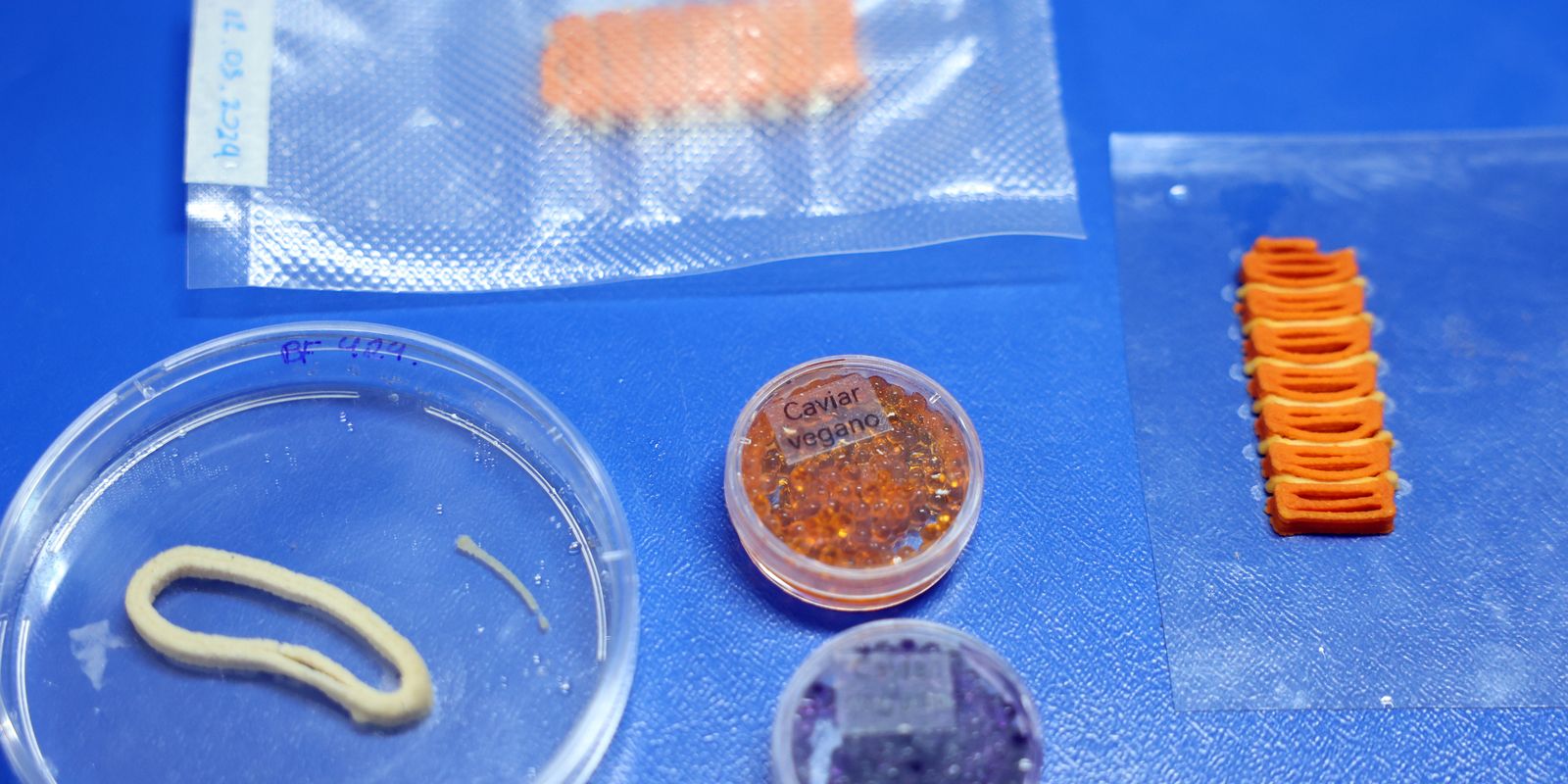
After 30 months of research, the Nanobiotechnology Laboratory (LNANO) at Embrapa Genetic Resources and Biotechnology, based in Brasília, has developed samples of 3D-printed plant-based foods that mimic salmon fillet, caviar, and squid rings.
Beyond copying the shape of foods, the prototypes—made on Embrapa's 3D printers—have taste and nutritional characteristics similar to the original food.
"One of the things we sought was to evaluate the nutritional content of animal meat in its total composition. Focusing on three main groups—carbohydrates, lipids, and proteins—we searched plant resources for ingredients or inputs that give us the same percentage amount as animal tissue," explains biologist Cínthia Caetano Bonatto, a researcher fellow at LNANO.
Food inks
The samples were created with food inks made from plant proteins, legume flours, vegetable and algal oils, nano-ingredients, natural dyes, and thickeners—used to increase the viscosity of foods.
According to Cínthia Bonatto, the food inks are made from ingredients "that, for the most part, are the same ones we use in cooking in our homes."
Noah's Ark
Some of these inputs were obtained from Embrapa's Active Germplasm Banks, a kind of "Noah's Ark" that collects in 140 collections the genetic material of thousands of plants, microorganisms, and animals.
With genetic material from Embrapa's own repository, it is possible to develop plant-based foods with a composition "as similar as possible to that found in animals," describes researcher Luciano Paulino da Silva, who coordinates food printing projects.
With this technology, researchers can "nutritionally enrich the printed products," comments biotechnologist Gabriela Mendes da Rocha Vaz, also a researcher fellow at LNANO.
This application could be useful in combating hunger and malnutrition. In theory, food printing could also prevent overfishing or animal suffering in slaughter and serve segments of the public with dietary restrictions—for example, those who do not want to eat meat.

Samples were created with food inks. Photo: Valter Campanato/Agência Brasil
On display
The foods created at LNANO have already been tasted by people, as approved by an ethics committee. According to Luciano Paulino da Silva, the experiment is "on display at Embrapa," but has no market launch date yet.
Embrapa's research was funded by the Good Food Institute (GFI), a global nonprofit that finances the creation of plant-based foods, foods with microorganisms in fermentation processes, and cultured meat produced from animal cells in laboratories.
Commercial exploitation will depend on the business model: foods created in home printers for restaurant preparation or at industrial scale.
Printed foods are already being sold in Australia, the United States, Israel, and Singapore. In Brazil, researchers at São Paulo State University (Unesp) are developing food printing experiments in partnership with Harvard University's School of Medicine and Singapore's University of Technology and Design.